The Chore Handoff: Make Recurring Tasks Visible
A clear chore handoff makes recurring tasks visible: name the work, define when it counts as done, and agree who takes responsibility next.
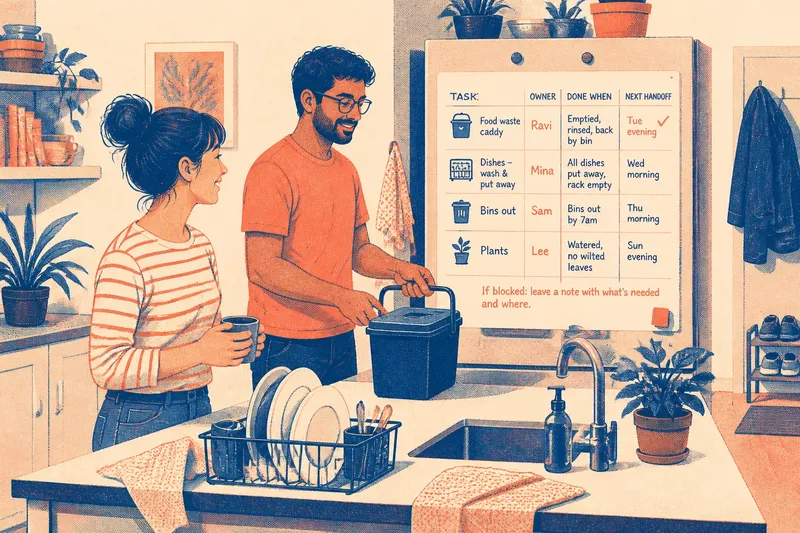
A clear chore handoff makes recurring tasks visible before a bin overflows or a sink fills with dishes. For any recurring chore, agree on three things: what the task includes, what counts as finished, and who takes responsibility next. That turns a vague expectation into work people can actually coordinate.
The handoff is the point where responsibility moves from one person to another, or returns to the person who owns the routine. It may happen after a task is completed, on a set day, or when a specific condition arises. Naming that moment matters: “Someone should deal with the recycling” has no owner or endpoint, while “Mina takes the recycling to the shared collection point on Tuesday evening, then leaves the empty caddy by the back door” describes a workable arrangement.
Agree on the task before assigning it
Start with a chore that regularly causes uncertainty. Write down its name, then describe the actions that belong to it. “Clean the kitchen” could mean wiping the worktop, washing pans, clearing the table or taking out rubbish. If housemates picture different work, they can each believe the other has left the job unfinished.
Keep the description narrow enough to recognise. For example, “reset the kitchen after dinner” might include washing or loading the dishes, wiping the table and worktop, and putting away food left on the counter. It need not include scrubbing the oven or reorganising a cupboard. Separate occasional deep cleaning from the recurring task instead of quietly adding it to the same label.
Talk through the description together, especially if the task crosses personal boundaries. One person may be comfortable washing another person’s mug but not sorting their belongings. Agree what happens to items that do not belong in the shared area: leave them in a named spot for their owner, rather than making the chore-owner guess where they go.
Define a completion point people can see
A task needs a finish line that does not depend on someone else noticing a general improvement. Choose a visible condition, such as the compost caddy being empty and returned to its place, or the bathroom mirror being wiped and the cloth hung up to dry. A clear endpoint prevents “I thought you meant later” from becoming part of the routine.
Distinguish completed work from work that is waiting on someone or something. If the dishwasher is full but still running, loading it is not the same as emptying it. The handoff can say what to do next: the person who runs it leaves the clean dishes for the next assigned person, or the same person returns when the cycle ends. Choose one arrangement and write it down.
Make exceptions visible too. If a task cannot be completed because the required supplies have run out, the chore-owner can leave a short note stating what is missing and where it is needed. That is a useful handoff, not a silent failure. Someone else can then decide whether to replace the item or adjust the task.
Set the handoff across a normal week
Use a small shared note, a paper chart on the fridge or a household app that everyone already checks. Record the task, its owner, its completion point and the next handoff. Avoid filling the system with commentary. It should answer who acts, what they do, and what another person should expect afterwards.
- At the start of the week: Confirm who owns each recurring task and note any known absence or schedule change.
- On the agreed day: The owner completes the described task by the agreed point, rather than relying on a reminder from another resident.
- At the finish: Leave the agreed visible signal, such as the clean caddy in its usual place or a tick beside the task.
- If the task is blocked: Note the obstacle and the next action needed, then contact the person who can make that decision.
- At the next handoff: The incoming owner checks the signal and takes over only the work included in the agreement.
Say you share a flat and the food-waste caddy has been left full after collection day. You agree that Ravi empties it on Tuesday, rinses it if needed, and returns it beside the kitchen bin; if the collection point is closed, he leaves a note saying the bag is still inside. The expected result is easy to recognise: the caddy is ready for use, or the next person can see exactly why it is not. No one has to infer whether Ravi forgot or thought somebody else would do it.
What should the chore handoff answer?
Who owns a task if two people usually share it?
Name one person as the owner for that turn, even if another person helps. The owner makes sure the agreed completion point is reached or leaves a clear note if the task is blocked.
Should a chore have a deadline or a trigger?
Use the one that fits the task. A weekday may suit putting the bins out, while a trigger such as “when the drying rack is full” may suit putting away clean dishes.
What should happen when someone cannot do their turn?
Agree on a simple swap process before the problem occurs: the person who cannot do the task asks a named housemate to take it, then updates the shared note. If nobody accepts the swap, the original owner remains responsible for communicating the next workable arrangement.
How can housemates tell whether the agreement is working?
Look for repeated uncertainty, missed handoffs or disagreement about what “done” means. Use those specific snags to revise the task description, endpoint or owner, rather than treating every lapse as a personal failing.
Adjust the agreement when the routine changes
Household routines shift when someone changes work hours, travels, gets ill or starts using a shared space differently. For a short absence, agree who covers the affected task and when the original owner resumes it. For a lasting change, update the note so the old arrangement does not remain the hidden default.
When a task is repeatedly left incomplete, first check whether its boundaries are clear. Perhaps “take out the rubbish” was understood to include replacing the liner, or one person thought the task happened only when the bin was full. Make the missing part explicit, then set the next handoff. If the agreed task is clear but consistently too much for one person, redistribute the work rather than disguising an unfair load as a reminder problem.
Keep the record focused on responsibilities, not on scoring people. A tick or brief note should show that work is finished or identify what remains; it should not become a running list of grievances. If a disagreement concerns standards, discuss the particular endpoint together and choose one everyone can recognise.
Keep the handoff simple enough to repeat
A chore handoff works when each person can tell what to do without interpreting hints. Give every recurring task a plain name, a concrete finish line and an agreed next owner or signal. Review only the parts that cause confusion, and change the arrangement when the household’s routine changes.
For your next recurring chore, write one sentence that names the owner, the action and the visible completion point. Add what happens if the task is blocked. That small chore handoff gives everyone a shared reference, and it makes the next person’s responsibility clear without asking them to guess.